R. Schumann: Album for the Young op. 68
Difficulty: 1-5
Edition type: urtext edition
Opus: op. 68
Dimensions : 25 x 32 x 2 cm
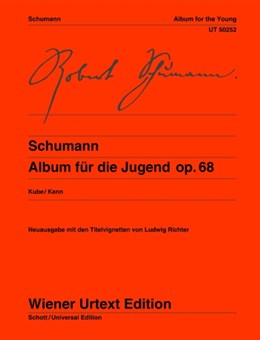
Robert Schumann's Album für die Jugend is one of the milestones of educationally inspired piano literature. This edition does not focus on systematic technical studies but on the development of the player's musical performance as well as on the realisation of musical associations. In this quite progressively structured work, the pieces 'Für Kleinere' [For the Younger Ones] are followed by a second section 'Für Erwachsenere' [For the More Grown-Ups] which, both technically and intellectually, leaves the world of the childlike behind again and again (e.g. Mignon). This, in particular, provides a largely underestimated repertoire for adults who want to resume piano playing, which gives double importance to Schumann's opus. The appendix of the revised new edition of the Wiener Urtext Edition also contains all pieces originally intended for the album which, in the end, were not included in the printed collection. The music section is complemented by the composer's 'Musikalische Haus- und Lebensregeln', which had already been integrated in the first reprints, including their original translations into English and French, the latter of which comes from none other than Franz Liszt.
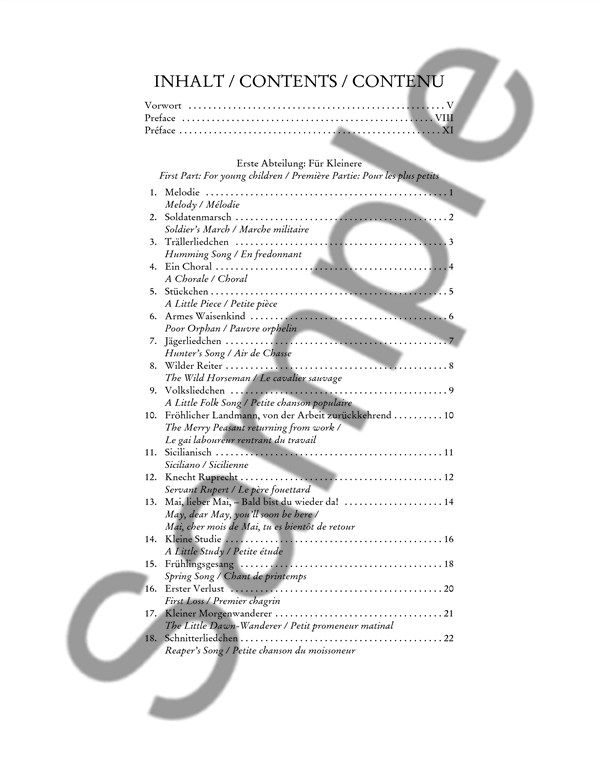
Contents:
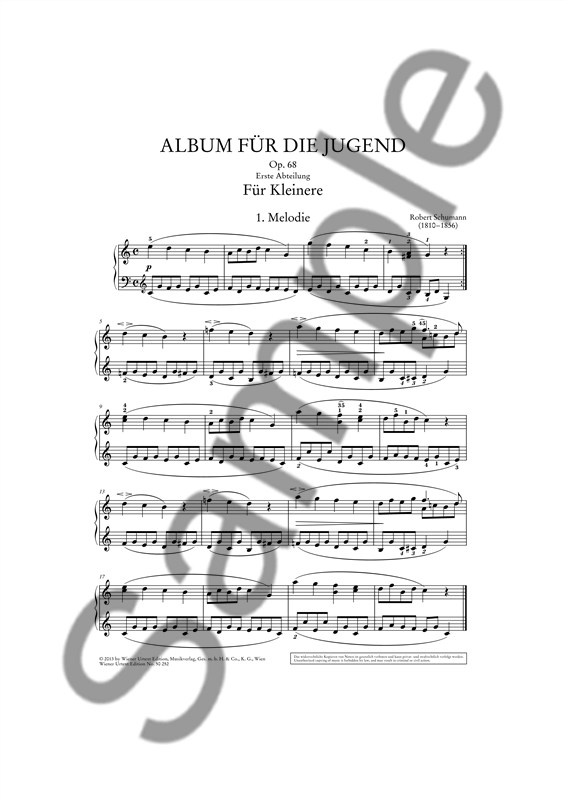
- Melodie / Melody / Mélodie
- Soldatenmarsch / Soldier's March / Marche militaire
- Trällerliedchen / Humming Song / En fredonnant
- Ein Choral / A Chorale / Choral
- Stückchen / A Little Piece / Petite pièce
- Armes Waisenkind / Poor Orphan / Pauvre orphelin
- Jägerliedchen / Hunter's Song / Air de Chasse
- Wilder Reiter / The Wild Horseman / Le cavalier sauvage
- Volksliedchen / A Little Folk Song / Petite chanson populaire
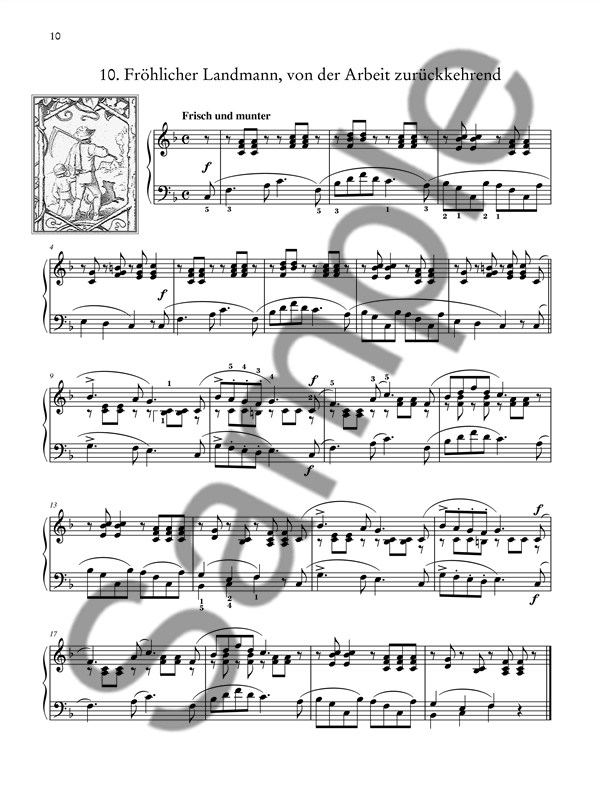
- Fröhlicher Landmann / The Merry Peasant / Le gai laboureur
- Sicilianisch / Siciliano / Sicilienne
- Knecht Ruprecht / Servant Rupert / Le moine bourru
- Mai, lieber Mai, - Bald bist du wieder da! / May, dear May, you'll soon be here / Mai, cher mois de- Mai, tu es bientôt de retour
- Kleine Studie / A Little Study / Petite étude
- Frühlingsgesang / Spring Song / Chant de printemps
- Erster Verlust / First Loss / Premier chagrin
- Kleiner Morgenwanderer / The Little Dawn-Wanderer / Petit promeneur matinal
- Schnitterliedchen / Reaper's Song / Petite chanson du moissoneur
- Kleine Romanze / A Little Romance
- Ländliches Lied / Rustic Song / Chant rustique
- ***
- Rundgesang / Roundelay / Ronde
- Reiterstück / The Horseman / Le cavalier
- Ernteliedchen / Harvest Song / Chanson des moissoneurs
- Nachklänge aus dem Theater / After the Theatre / Souvenirs du Théâtre
- ***
- Canonisches Liedchen / A Little Song in Canon / Petit chant en forme de canon
- Erinnerung / In Memory / Souvenir
- Fremder Mann / A Stranger / L'étranger
- ***
- Kriegslied / Battle Song / Chant guerrier
- Sheherazade
- "Weinlesezeit - Fröhliche Zeit!" / 'Vintage Time - Merry Time' / " Temps de vendages - Temps joyeux "
- Thema / Theme / Thème
- Mignon / Lied italienischer Marinari / Italian -Marinaris' Song / Chant des mariniers italiens
- Matrosenlied / Sailors' Song / Chant des matelots
- Winterszeit I / Wintertime I / En hiver I
- Winterszeit II / Wintertime II / En hiver II
- Kleine Fuge / Little Fugue / Petite fugue
- Nordisches Lied / Nordic Song / Chant nordique
- Figurierter Choral / Figured Chorale / Choral figuré
- Sylvesterlied / New Year's Eve Song / Chant de la Saint Sylvestre
- Für ganz Kleine / For the very Small / Pour les tout petits
- Puppenschlafliedchen / Doll's Lullaby / Petite berceuse pour la poupée
- Ein Trinklied von C. M. v. Weber / A Drinking Song by C. M. v. Weber / Une chanson à boire de C. M. v. Weber
- [Ein Thema von Beethoven] / [A Theme by Beethoven / Un Thème de Beethoven]
- Auf der Gondel / In a Gondola / Sur la gondole
[Ein Stückchen von Gluck] / [A Little Piece By Gluck / Une petite pièce de Gluck]
- Gukkuk im Versteck / Hide and Seek / Cache-cache
- Haschemann / Catch me if you can / Colin-Maillard
- Ein Stückchen von Mozart / A Little Piece by Mozart / Une petite pièce de Mozart
- Bärentanz / Bear-Dance / Danse de l'ours
- Ein Stückchen von J. S. Bach / A Little Piece by J. S. Bach / Une petite pièce de J. S. Bach
- Ein Thema von G. F. Händel / A Theme by G. F. Handel / Un thème de G. F. Haendel
- Eine berühmte Melodie von L. van Beethoven / A Famous Melody by L. van Beethoven / Une mélodie célèbre de L. van Beethoven
- Ein Ländler von Franz Schubert / A Ländler by Franz Schubert / Un Ländler de Franz Schubert Ein Ländler von Franz Schubert / A Ländler by Franz Schubert / Un Ländler de Franz Schubert Ein Ländler von Franz Schubert / A Ländler by Franz Schubert
- Rebus
| Product Code |
: |
UT50252 |
| Shipping Weight |
: |
0.40 kilograms |
Disclaimer : Image(s) shown is (are) served as product illustration only. It is used for general guidelines for customer visualization.